Current #1
AI is blurring our notions of relational trust, shifting our sense of what is “real” and “authentic.“
Last year, one of the young people in our network asked Michelle, The Rithm Project’s founder, whether he could play with her likeness. They had just finished a recording session, and the footage was sitting right there. She said yes. A few hours later, a video came back: Michelle, looking into the camera, selling sweatpants.
2025
“I’ve been sitting in meetings all day, and I feel like I’m wrapped in a cloud. I’ve already ordered two more pairs. You should too.”
The catch: Michelle does not own sweatpants. And she never said those words.
The deepfake technology behind this video — already dated in its sophistication — is one more marker in a rapidly advancing set of offerings. When image generators first hit the public in 2022, typing “woman smiling in the sun” got you a smear of teeth and sunlight. Three years later, it gets you a person you would swear just joined your video call.

2022
You, but not.
Editing images is not new. For decades we’ve been throwing filters on photos, and professionals have been altering the images that grace our movies and magazines. What is new is the realism — and the fact that anyone can now do it in seconds, inside the default photo app on their phone. In Google’s Magic Editor, the photo on the left is real. The photo on the right adds drug paraphernalia. Same person, same living room. Very different meaning, with vastly different consequences.
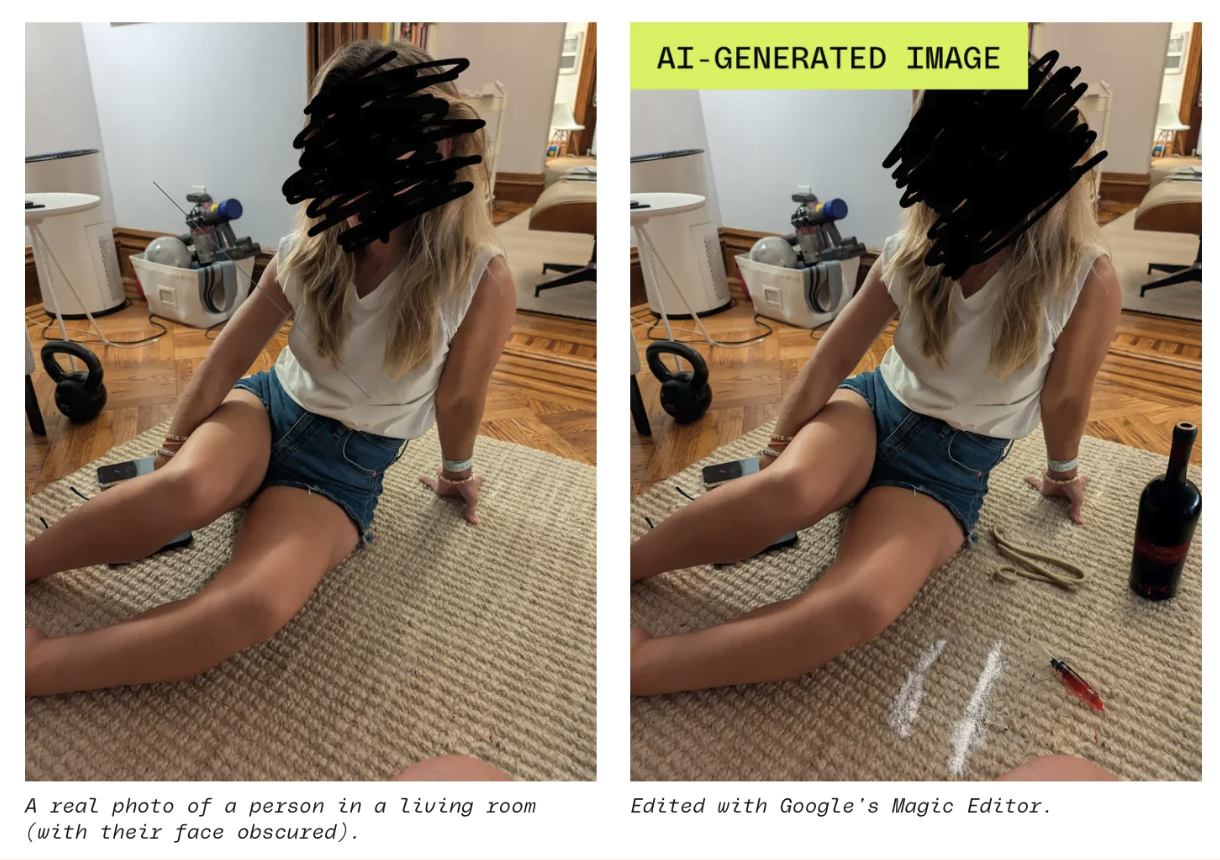
When we show this image to teenagers, the dilemma it poses is all too familiar. They ask: how do I know that someone’s gonna do right by my likeness? The picture of me from the football game, from the party — how can I trust that I will be represented the way I actually am?
And the harm is not equally distributed. Deepfake “nudification” apps, for example, have spread through middle schools, high schools, college campuses, and workplaces. They are used overwhelmingly on girls and young women, who are stripped without their consent.
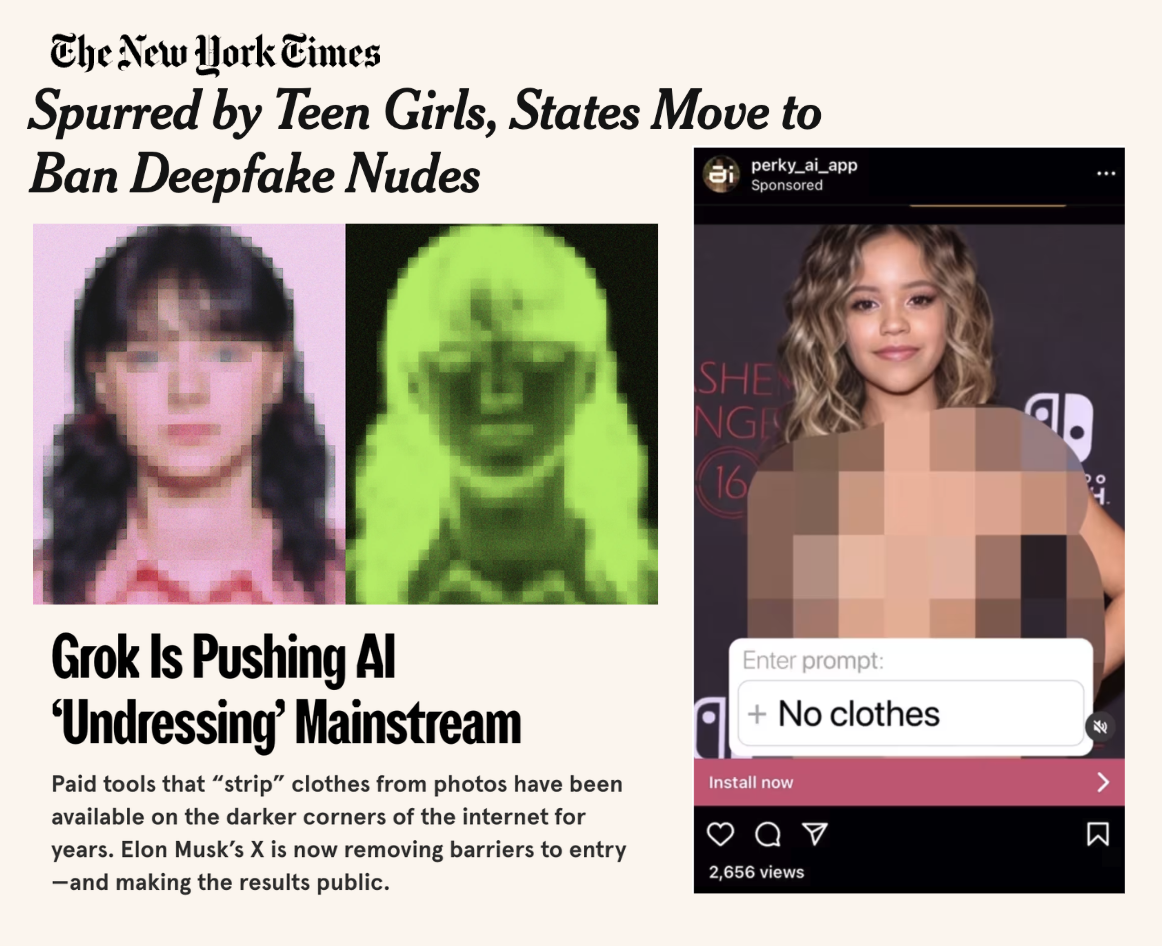
Given the prevalence of these tools, young people growing up in an AI world are all too aware that their image is a malleable resource — and that they are swimming in content that may not be what it appears.
You, but available to others.
Alongside the manipulation of other people’s likenesses, a growing number of people are opting to create digital twins: avatars that look and sound like them, and that pull from a bank of knowledge that is theirs — but available to the masses.
One example: Caroline Hill spent years building a body of work called Equity by Design. Until recently, benefiting from that wisdom required being on her limited client roster. So she built Gladys, a digital twin that can counsel anyone through the equity dilemmas they are facing in their own worlds. Not only does this make her expertise available to more people, it offers a more comfortable entry point for grappling with challenging subjects than some people would be willing to risk with a real person on the other end.

Across industries, twins like Gladys are multiplying: bosses who let their AI personas run check-ins with direct reports or renowned professors hosting office hours 24/7 with a bot. This is inviting a real distribution of expertise, while prompting people to grapple, in real time, with what is replicable and what can’t be reproduced by technology.
AI enters the chat.
Our visuals are not the only place where AI is infusing itself in ways that complicate our sense of authenticity.
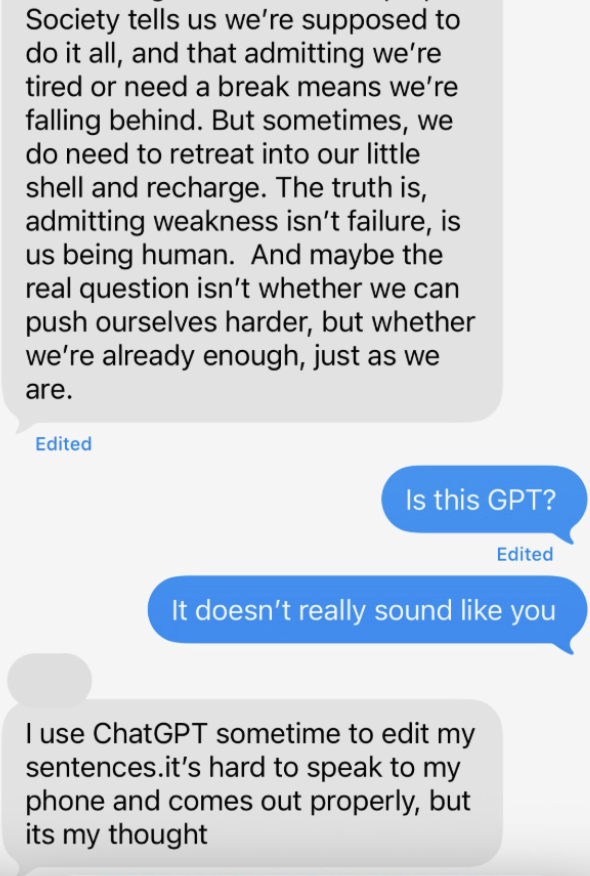
In our national survey, 1 in 4 young people told us they are talking to AI to help them communicate — including in their texts, emails, and direct messages on social platforms.
Sometimes that help deepens a relationship. Young people described practicing how to de-escalate a conflict, or how to phrase something hard so it lands with care. Sometimes it corrodes the conversation instead, inserting a filter that’s hard to connect through.
AI IRL.
That sense of “is that really you saying that?” is no longer confined to our devices. AI is showing up in our in-person interactions too.
A few years ago, two Harvard students took Meta’s Ray-Ban smart glasses and, in three days, added facial recognition — glasses that can tell you who a stranger is as you walk up to them, equipping you with details about their job, their social media presence, their interests.
Glasses are only the beginning. Recording pendants, pins, and bracelets are already being worn into classrooms, dinners, and first dates. The presence of an always-listening device changes a conversation between two people, whether or not anything is ever played back.
Young people are quickly resetting the expectations they carry into the spaces they move through, digital or IRL: assume you are being recorded.
But they are also fighting back to reclaim privacy. One young founder built Deveillance, a small box that scrambles nearby recording devices. The engineering matters less than the gesture: you set the box on the table, and everyone understands. It is a new kind of body language — a way of saying this moment is just ours in a world where that can no longer be assumed.
The current.
Across all of these examples, you can see how this technology is disorienting for a generation whose sense of what is real and authentic is blurring.
At the extremes, young people are consuming — or being turned into — fake content that is intentionally misleading. Far more often, it is subtler than that: the meeting notes synthesized through a company’s filter. The performance review with your first boss, written by his bot. The birthday text, polished. And running through it all is the question this current keeps prompting: where will we reinvent our sense of what’s “real,” and where — as a society and as individuals — will we choose to put a stake in the ground on authenticity?
Reflect.
Take a moment to consider or journal about the implications of this current. Across the examples:
Where have you already experienced this current — in your own tech use, your social circles, your community, your work?
What is the upside for human connection? How might this technology show up in ways that support healthy relationships?
What are the biggest risks for human connection? And who carries them first?
Explore the other currents: